Transportation Goals

GOAL: Reduce employee drive alone rate to 36% by 2025
STATUS: Achieved
GOAL: Reduce emissions from business air travel by 10% by 2025 compared to 2019 baseline
STATUS: Achieved
GOAL: By 2030 all low speed neighborhood vehicles (including non-licensed carts) will be all electric or zero-emission
STATUS: In progress
Campus Performance Overview
UC Berkeley offers a comprehensive package of programs to UC Berkeley faculty, staff, and students to encourage more sustainable forms of transportation. Bus pass programs, transit subsidies, discounted carpool parking pricing, pre-tax purchases, regional ride-matching services, and a host of other benefits and incentives aim to reduce traffic, parking demands, and fossil fuel consumption while improving air quality.
Performance highlights
-
Faculty, staff, and students commute via walking around 9.6 million miles per year.
-
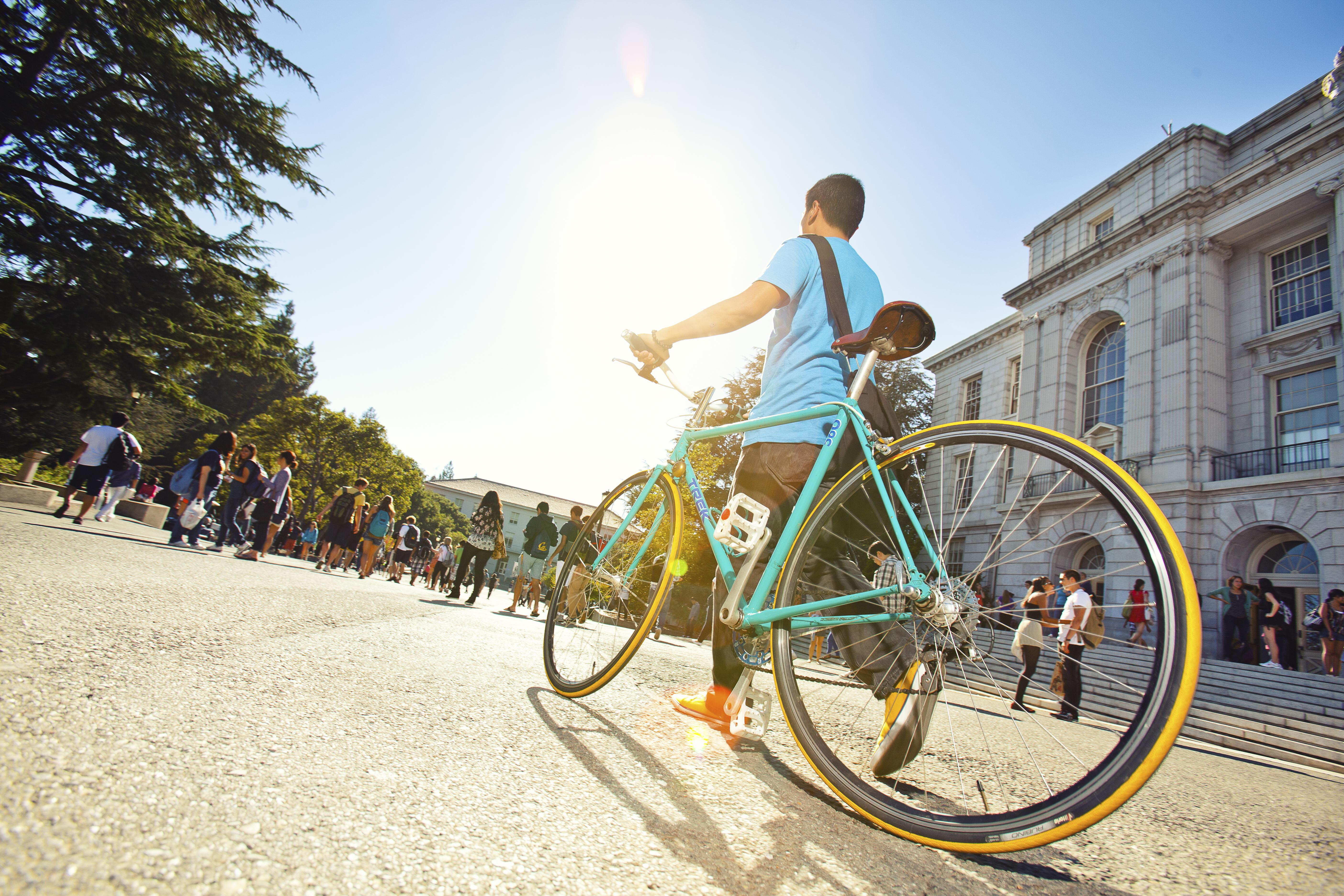
The campus transportation survey found that over 8% of all campus commuters–nearly 15% of faculty, 6% of staff, 8% of students– ride a bike to campus.. This totals 10.1 million bicycle commuter miles per year.
-
The campus now maintains 15 EV charging stations in their parking facilities. The Recreational Spots Facility (RSF) garage has 8 SAE J1772 charger types, and the Upper Hearst Structure has 1. The Foothill lot has 6 BEAM EV ARC outlets (110V). For information on pricing, permits, and hours, see Berkeley Parking and Transportation’s EV Charging guide
-
In 2022, miles flown on business air travel reduced by 30% compared to a 2019 baseline. Miles flown on business air travel are over 90 million miles a year.
Air travel represents the second largest source of carbon emissions on campus–25,000 metric tons of carbon dioxide each year! To address this, the UC Berkeley Office of Sustainability now sponsors and manages the Business Air Travel Carbon Mitigation ProgramThe program helps UC Berkeley find more sustainable alternatives to air travel when possible. When air travel is necessary, the program assigns a small fee for trips taken ($10 per domestic trip and $25 per international trip) and invests the money into projects that reduce the campus’s carbon footprint.

STARS Performance Overview
Transportation Category
According to STARS, "This subcategory seeks to recognize institutions that are moving toward sustainable transportation systems. Transportation is a major source of greenhouse gas emissions and other pollutants that contribute to health problems… . At the same time, campuses can reap benefits from modeling sustainable transportation systems. Bicycling and walking provide human health benefits and mitigate the need for large areas of paved surface, which can help campuses to better manage storm water."
Berkeley's STARS Performance
Total Points Available: 7.00
Transportation Points Claimed: 5.41
-
The campus achieved 77% of available points in the STARS Transportation category. The average among all research universities is 55%.
-
Built in one of the densest urban areas in the country, UC Berkeley prospers from a wealth of sustainable transportation options. As reflected in the STARS tool, 95% of students use bicycles, buses, and other sustainable options as their primary mode of transportation to campus.
-
Berkeley has a number of flex-fuel gasoline/E85 vehicles, which are not considered green vehicles by STARS standards. Additionally, the campus owns several vehicles that are partial zero-emission vehicles and electric carts that are used on campus that are not included in STARS standards.
Curious About Sustainable Travel?
View a informational pamphlet about sustainable travel here.
Research

The Institute of Transportation Studies (ITS Berkeley) innovates solutions for moving people and goods in ways that improve sustainability, economic health, and quality of life at UC Berkeley. A sample of ITS research projects include integrating electric vehicles into California’s electric grid; measuring the effects of the Clean Air Act on Pollution in relation to equity; using dynamic modeling and serious games to reduce wildfire risk in Northern California.
Transportation Highlights
BerkeleyMoves is UC Berkeley's Official RideShare Matching and Trip Planning platform!
Students, Staff, and Faculty can find:
-
Transit, Carpool, or Bike Planning
-
Rideshare & Carpool Partners - to get you to campus OR to get you back home!
-
Event Planning and Carpool Matching (for Spring, Winter & Summer holiday, Concerts, or Sports events) and contests for various events or programs.
